I study the evolution of complex traits, such as color patterns, brains and behavior. To that end, I combine large-scale phenotypic and genetic datasets with methodological advances, such as machine learning and statistical modelling. I also publish open-source software, such as the R packages phylopath for phylogenetic path analysis and phylosem for phylogenetic structural equation models.
I am currently working as a Research Associate in the lab of Judith Mank, at UBC. My current work focuses on the evolution and genetic basis of the highly variable color patterns of the Trinidadian Guppy.
Previously, I worked in the lab of Chris Wheat on butterfly coloration. Before that, I was a PhD student with Niclas Kolm studying the function and evolution of brain size. For my thesis I performed experiments on brain size in guppies, and performed comparative analyses on the same topic.
PhD in Ethology, 2018
Stockholm University
MSc in Behavioral and Cognitive Neuroscience, 2013
University of Groningen
BSc in Life Science & Technology, 2010
University of Groningen
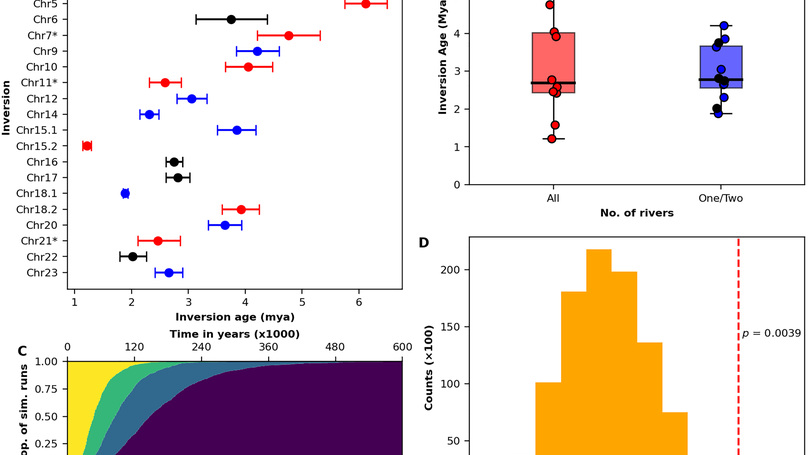
Understanding the distribution, frequency, and long-term persistence of chromosomal inversions in natural populations is key to understanding population evolution and adaptive processes. Inversions often span multiple genes, are subject to strong selective pressures and can affect complex traits. Here, we used an unbiased method to identify inversions in guppies from three different Trinidadian rivers with paired high- and low-predation populations which differ in a wide range of morphological, behavioural and life-history traits. We identified 22 inversions, ranging in age from 1 to 6 million years, which are widespread across the genome and predate the colonisation of each river. We were able to verify the breakpoints for all but one of these inversions using linked reads. We find three inversions that are significantly associated with local adaptation syndromes in high- versus low-predation populations, however, none are reciprocally fixed throughout all three replicate rivers. Additionally, we observe seven additional inversions maintained in all three rivers without evidence of local adaptation. Simulations reveal that the level of inversion polymorphism that we observe is far greater than expected under a neutral model. We observed a significant overlap between polymorphic inversions and loci previously implicated in male ornament pattern variation in guppies, suggesting that negative frequency-dependent selection due to female preference for male pattern novelty might explain the maintenance of inversion polymorphism. Overall, our results show the role of sexual selection in the long-term maintenance of inversion polymorphisms, and an interplay between sexual and natural selection in frequency dynamics.

For more than a billion years, anisogamy has set the stage for sexual dimorphism, driving the evolution of distinct male and female phenotypes from the same genome. There has been a longstanding emphasis on the constraints imposed by shared genetic architecture, framing the evolution of the sexes largely in terms of sexual conflict. Yet the remarkable extent and diversity of sexual dimorphism illustrates that evolution repeatedly produces a wide range of discrete phenotypes within species, demonstrating constraints on the evolution of dimorphism may often be transient and thus difficult to detect at the genomic level. Here, we synthesize insights from quantitative genetics, genomics, and experimental evolution to examine how readily genomes generate and maintain sex-specific variation. We review evidence that regulatory mechanisms can evolve rapidly using existing sex-specific architectures and that many traits already exhibit partially decoupled genetic architectures even when sexually monomorphic. We evaluate attempts to identify genomic signatures of constraint, discuss limitations of current theoretical models, and consider what is known about the tempo and repeatability of sexual dimorphism across lineages. Together, these findings highlight the evolutionarily flexibility of genomes, and the many mechanisms by which evolution navigates the restrictions of genomic constraints to allow for sex-specific adaptation.

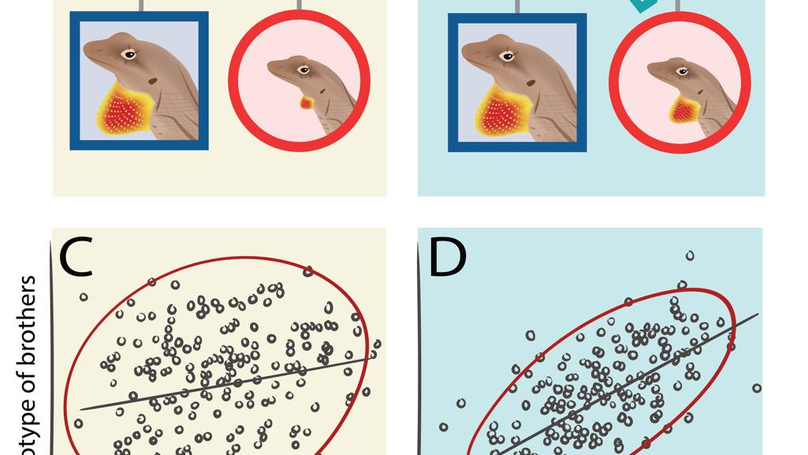
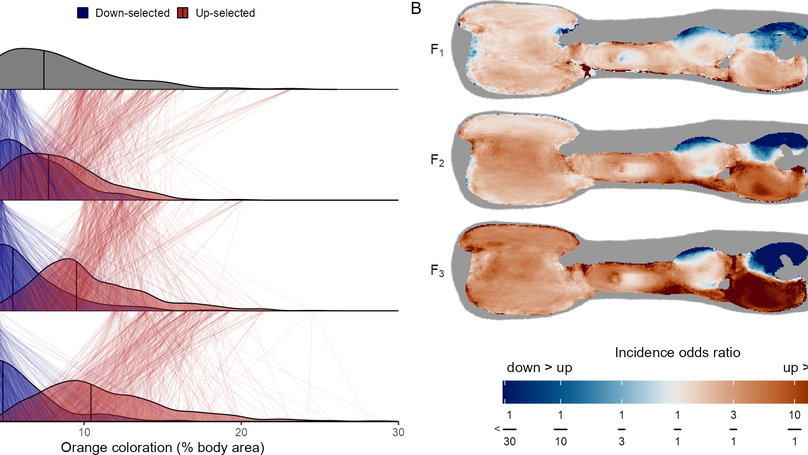
The extraordinary variation in male guppy (Poecilia reticulata) colouration is a powerful model for studying the interplay of natural and sexual selection. However, the complexity of this variation has hampered the high-resolution characterization and determination of the genetic architecture underlying male guppy colour and clouded our understanding of how this exceptional level of diversity is maintained. Here we identify the heritability and genetic basis of male colour variation using convolutional neural networks for high-resolution phenotyping coupled with selection experiments, controlled pedigrees and whole-genome resequencing for a genome-wide association study of colour traits. Our phenotypic and genomic results converge to show that colour patterning in guppies is a combination of many heritable features, each with a largely independent genetic architecture spanning the entire genome. Autosomally inherited ornaments are polygenic, with significant contributions from loci involved in neural crest cell migration. Unusually, the results of our genome-wide association study suggest that gene duplicates from the autosomes to the Y chromosome are responsible for much of the sex-linked variation in colour in guppies, providing a potential mechanism for the maintenance of variation of this classic model trait.

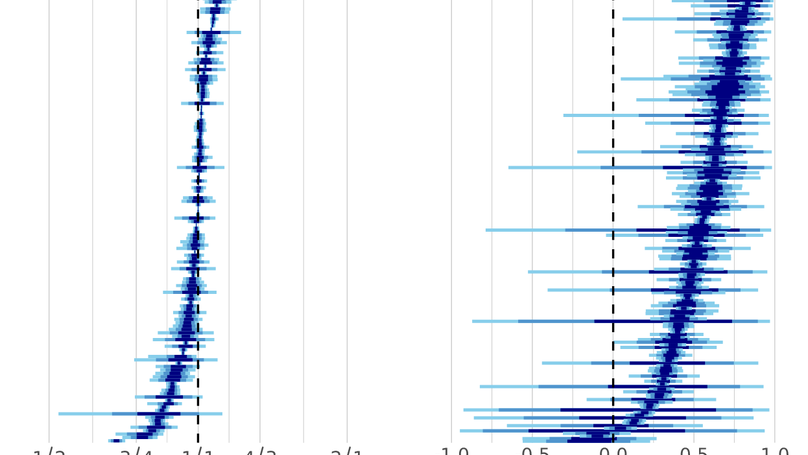
The majority of the genome is shared between the sexes, and it is expected that the genetic architecture of most traits is shared as well. This common architecture has been viewed as a major source of constraint on the evolution of sexual dimorphism (SD). SD is nonetheless common in nature, leading to assumptions that it results from differential regulation of shared genetic architecture. Here, we study the effect of thousands of gene knockout mutations on 202 mouse phenotypes to explore how regulatory variation affects SD. We show that many traits are dimorphic to some extent, and that a surprising proportion of knockouts have sex-specific phenotypic effects. Many traits, regardless whether they are monomorphic or dimorphic, harbor cryptic differences in genetic architecture between the sexes, resulting in sexually discordant phenotypic effects from sexually concordant regulatory changes. This provides an alternative route to dimorphism through sex-specific genetic architecture, rather than differential regulation of shared architecture.

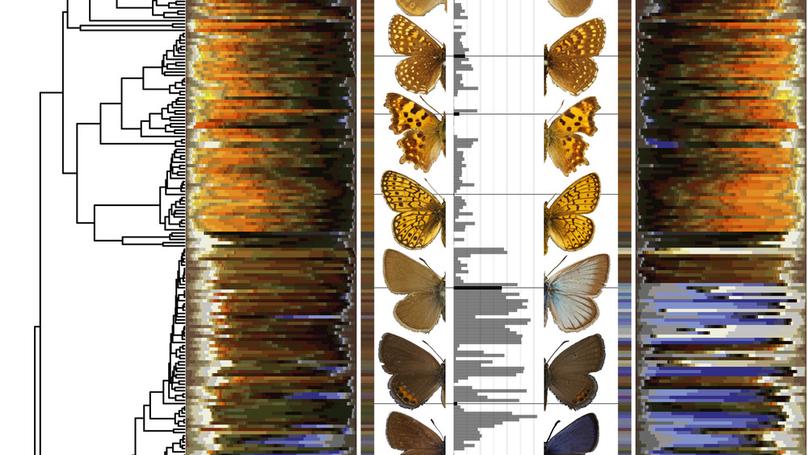
Sexual dimorphism is typically thought to result from sexual selection for elaborated male traits, as proposed by Darwin. However, natural selection could reduce expression of elaborated traits in females, as proposed by Wallace. Darwin and Wallace debated the origins of dichromatism in birds and butterflies, and although evidence in birds is roughly equal, if not in favor of Wallace’s model, butterflies lack a similar scale of study. Here, we present a large-scale comparative phylogenetic analysis of the evolution of butterfly coloration, using all European non-hesperiid butterfly species (n = 369). We modeled evolutionary changes in coloration for each species and sex along their phylogeny, thereby estimating the rate and direction of evolution in three-dimensional color space using a novel implementation of phylogenetic ridge regression. We show that male coloration evolved faster than female coloration, especially in strongly dichromatic clades, with male contribution to changes in dichromatism roughly twice that of females. These patterns are consistent with a classic Darwinian model of dichromatism via sexual selection on male coloration, suggesting this model was the dominant driver of dichromatism in European butterflies.